Building Young Communicators
Quick Navigation
- Building Young Communicators
- Age-Appropriate Communication Development
- Communication Milestones by Age: What to Expect
- The 8-Step Parent's Framework for Building Communication Skills
- Supporting Children with Communication Difficulties
- Communication Skills and Academic Success
- Digital Communication Skills for Children
- Bilingual and Multilingual Communication Development
- Frequently Asked Questions
A child learns to communicate the way a child learns almost everything else: by being in the middle of it. Long before a toddler can explain what they want, they are reading faces, tracking tone, and testing what a sound or a gesture gets them. That is the real curriculum. The adult who narrates the grocery aisle, the parent who waits an extra beat for a half-formed answer, the grandparent who looks up from the phone — those ordinary moments build the skill.
Supporting that work does not mean turning it into a project. Most of it is not complicated, though some of it runs against the instinct to correct, finish sentences, or rush a slow answer. The literature on communication keeps pointing back to a few durable habits: model the behavior you want, listen in a way the child can feel, name feelings out loud, and meet the child where they are rather than where a chart says they should be. And children develop on their own clocks. The spread of "normal" is wide, a late talker is not a failing communicator, and the point is to keep the conversation going rather than hit a number on schedule.
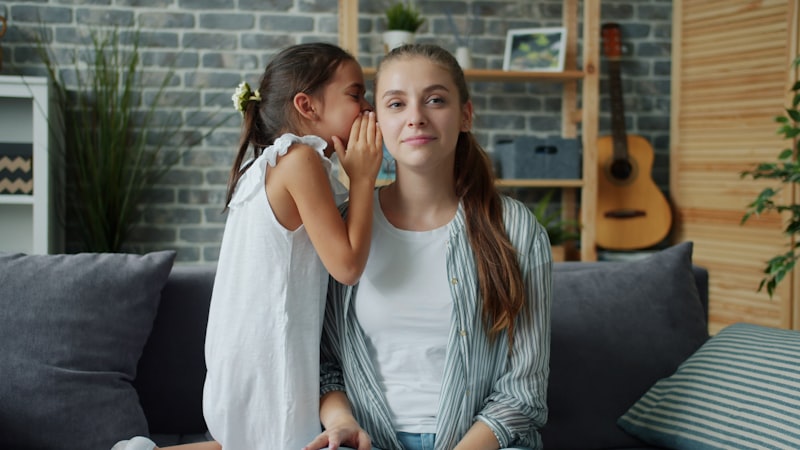
Age-Appropriate Communication Development
"Age-appropriate" gets misused. People hear it as a deadline. A better way to hold it: the conversation that fits a child shifts as the child grows, and the adult's job is to keep adjusting the input rather than enforce an output. What you say to a two-year-old, how much you expect back, and what counts as a good exchange all look different at five, at nine, at thirteen.
With the youngest children, communication is mostly about responsiveness. A baby babbles, an adult babbles back, and the baby learns that sounds get answered. That loop, sometimes called serve-and-return, is the foundation, and it costs nothing but attention. Naming things helps too. A child who hears "you're holding the red cup" hundreds of times in ordinary moments absorbs vocabulary in a way no app replicates, because it is tied to something real in their hands.
Toddlers and preschoolers reach the stage where they have a lot to say and not always the words to say it. This is the patience-testing window. The temptation is to fill in the blank or supply the word before they reach for it. Resist where you can, because the few seconds a child spends searching for a word is the work, and when you jump in you do that work for them. Expanding on what they said — child says "dog run," you say "yes, the dog is running fast" — adds structure without correcting them into silence.
School-age children can handle more. They can follow a longer thread, hold an opinion, and start to grasp that the person across from them might see things differently. This is a good age to bring in the mechanics of conversation on purpose: taking turns, not interrupting, asking a question back. It is also when emotional vocabulary starts to matter for getting along with peers, which is where Goleman's framing of emotional intelligence earns its keep. A child who can say "I'm frustrated" has a tool a child who can only slam a door does not.
Adolescents are their own category. The talkative eight-year-old can turn into a one-word teenager, and a lot of that is normal individuation, not a communication breakdown. The adults who keep the channel open through those years tend to be the ones who listen more than they lecture and can tolerate a car ride of silence without filling it. The skills built earlier do not vanish. They go quiet and resurface.
Communication Milestones by Age: What to Expect
Milestones are useful as a rough map and dangerous as a stopwatch. They describe what tends to develop in roughly what order, which helps you know what to support next, but they do not set a schedule any individual child is obligated to keep. Use the table below as orientation, not as a test the child is passing or failing. Wide variation at every stage is the rule, not the exception.
| Stage | What communication tends to look like | How an adult can support it |
|---|---|---|
| Infancy | Babbling, eye contact, reaching, responding to familiar voices; sounds become a way to get a response. | Babble back, name what the baby looks at, respond to early sounds as if they were conversation. |
| Toddler years | First words, then short combinations; a lot of meaning carried by gesture and tone when words run out. | Expand on what they say, wait for them to reach for words, read aloud often, narrate daily routines. |
| Preschool years | Longer sentences, endless questions, early storytelling; can hold a short back-and-forth. | Answer the questions, ask open ones back, let them tell the whole rambling story without rushing it. |
| Early school years | Follows and tells longer narratives, grasps that others have different views, starts naming feelings. | Teach turn-taking and not interrupting on purpose; help them put names to emotions as they come up. |
| Older childhood and adolescence | Abstract reasoning, persuasion, conversational subtlety; may also go notably quieter with adults. | Listen more than you correct, keep the channel open, model hard conversations rather than lecturing. |
If you take one thing from a milestone chart, make it this: watch the trajectory, not the date. A child who is steadily adding words, even slowly, is usually on a fine path. What earns a closer look is not lateness on its own but a plateau or a loss of skills the child already had.
The 8-Step Parent's Framework for Building Communication Skills
Frameworks for parenting can curdle into checklists nobody follows. The eight habits below are not a curriculum and not a sequence. Think of them as the handful of moves that show up again and again when adults work through a structured communication practice plan, translated for life with a child. You will do some without thinking. Others take deliberate effort, because they cut against the parental reflex to fix, hurry, or improve.
Model the listening you want back. Children copy what adults do far more than what adults say. If you want a child who listens, let them watch you listen, to them and to other people. Rogers and Farson's idea of active listening, the full-attention, reflect-back kind, works on a six-year-old as well as it works in a boardroom. Put the phone down and mean it; they notice the difference between your attention and your performance of it.
Give answers time to arrive. The most undervalued parenting skill might be the pause. A child needs longer than an adult to assemble a thought into words. Ask a question, then actually wait. The silence feels long to you and feels like working space to them. Filling it teaches them that someone else will always do the talking.
Expand, don't correct. When a young child says something half-formed, repeating it back in fuller form gives them the model without the sting of being marked wrong. "Me goed to the park" becomes "you went to the park, that sounds fun." They hear the correct version and the message that what they said mattered.
Name feelings out loud. Emotional vocabulary heads off a lot of meltdowns, because a child who has words for what is happening inside has an alternative to acting it out. This is the heart of Goleman's emotional-intelligence argument and, in a parenting register, the kind of emotion-focused approach John Gottman has written about for families. Put a name to the feeling in the moment — "you're disappointed the playdate ended" — without rushing to fix it.
Read aloud, and keep reading. Reading together does several jobs at once. It pours in vocabulary the child would not meet in daily talk, models how sentences hold together, and builds an unhurried shared attention that is increasingly rare. The conversation around the book, the "why do you think he did that?" asides, matters as much as the words on the page.
Ask questions that need more than yes. "Did you have a good day" gets you "fine." "What was the best part of your day" gets you a story, or at least a sentence. Open questions invite a child to build a longer answer, the exact muscle conversation depends on, and they tell the child you actually want the answer.
Let them finish, and teach the turn. Conversation is taking turns, and that has to be learned. Let a child complete a thought before you respond, and they learn that their turn will come. Name the rule gently when it slips: "I want to hear you, and I'm going to finish my sentence first." Modeled turn-taking beats a lecture on manners.
Stay calm in hard conversations. The way you handle conflict is the template a child files away for their own. A parent who can disagree without contempt, repair after a blowup, and keep talking when shutting down would be easier is teaching conflict resolution by demonstration. Gottman's work on what corrodes relationships, contempt above all, is a useful warning here: the habits that wreck adult relationships start looking familiar in the parent-child one.
Supporting Children with Communication Difficulties
Some children find communication harder than their peers. A speech or language difficulty, a hearing issue, a stammer, the communication differences that come with autism, or plain shyness all land differently and call for different responses. The starting point is the same: difficulty is not deficiency, and a child who struggles to talk is not a child who has nothing to say.
The most useful early stance is patient observation without panic. A child who is slow to talk, or talks but is hard to understand, or avoids back-and-forth, is giving you information rather than a diagnosis. Keep the input rich and the pressure low. Pressuring a struggling communicator to perform, with "say it properly" or "use your words" repeated until it stings, tends to backfire, adding anxiety to an already hard task. Warmth and time do more.
For a child who stammers, the old advice to slow down or "think before you speak" usually makes it worse by adding self-consciousness. Better to model an unhurried pace yourself, give them room to finish without finishing for them, and keep your reaction calm so the stammer does not become a source of shame. For a shy child, the move is exposure without force: low-stakes chances to talk, no spotlight, no performing for relatives on command. The same gentle, gradual approach behind good public-speaking practice applies in miniature here — confidence grows from small successes, not from being thrown in front of an audience.
Children with autism or other developmental differences may communicate in ways that do not match the usual script, and the goal is connection on terms that work for them, not conformity to a neurotypical default. Honoring how a particular child communicates, through gestures, routines, or alternative methods, respects the child and tends to open more doors than insisting on eye contact and small talk. When a difficulty is persistent or you are unsure, professional input is the right call.
Communication Skills and Academic Success
Communication and school feed each other, and the link is not mysterious. Almost everything in a classroom runs on language: following instructions, reading, writing, asking for help, working with other kids, explaining an answer. A child who can express a thought and understand one has an easier time with all of it. This is not about being the loudest talker. A quiet child with strong listening and clear expression is well served.
The vocabulary a child carries into school matters because so much of learning is built on words they are assumed to already know. A wide spoken vocabulary, built through conversation and reading at home, gives a child more to work with when new concepts arrive wearing unfamiliar labels. This is one of the strongest practical arguments for reading aloud early and often: it stocks the shelves before school starts pulling things off them.
Listening is the half of communication schools depend on and rarely teach directly. A child who can attend to an instruction, hold it, and act on it has a real advantage, and the active-listening habits adults model at home carry straight into the classroom. The social side works the same way: school is a dense communication environment of group work, friendships, and playground conflicts, and the children who can name a feeling, take a turn, and repair after a fight get through it with less friction. None of which means a quiet or late-talking child is headed for trouble. Plenty of strong students are reserved. The fair claim is narrower: the everyday habits a family builds at home happen to be exactly the tools school asks for.
Digital Communication Skills for Children
Children are growing up communicating through screens, and pretending otherwise helps nobody. Texting, video calls, group chats, comments, and games with built-in voice chat are part of how kids relate now. The question for families is not whether to allow digital communication but how to help a child do it with the care you would want them to bring to talking face to face.
Start with the limits of the medium. A lot of what carries meaning in person (facial expression, tone of voice, timing) thins out or vanishes in text. This is the legitimate, narrow version of a much-abused idea about body language and nonverbal communication. Albert Mehrabian's 1967 studies are often flattened into "most communication is nonverbal," which is a misreading; what his work actually found was that when someone's words and their tone or face disagree about a feeling, listeners lean on the tone and the face. Mehrabian spent years telling people to stop stretching that into a rule about communication in general. The takeaway for a child sending a text: tone is easy to lose on a screen, jokes fall flat, and "fine." can read as anger when none was meant. Teaching a kid to reread a message before sending, and to give the other person the benefit of the doubt, is real digital literacy.
The deeper habit is treating people online as people. The distance and the screen make it easier to be careless or cruel, and children need help seeing that a real person is on the other end. The standards you would set for in-person talk — do not say what you would not say to someone's face, do not pile on, do not share what was told to you in confidence — apply with extra force online, where words are permanent and screenshots travel. How you talk in your own messages and posts teaches more than any rule.
Protect the kind of communication screens crowd out, too. The unhurried, face-to-face conversation, whether at the dinner table, on a walk, or at bedtime, is where a lot of relational skill gets built, and it is the first casualty of a household where every face points at a device. Family rules about phones during meals are not about being anti-technology. They keep the in-person channel open, which is still where the richest communication happens.
Bilingual and Multilingual Communication Development
Raising a child with more than one language is a gift, and a surprising number of families talk themselves out of it on the strength of myths. The biggest is that two languages confuse a child or hold back development. The opposite is closer to the truth: children's brains are well suited to learning more than one language, and growing up bilingual is an asset, not a handicap. Plenty of children worldwide grow up speaking two or three languages as a matter of course.
A few patterns reassure parents who worry. Bilingual children sometimes mix languages within a sentence, which looks like confusion and is actually a normal, even sophisticated, feature of how multilingual speakers operate. Some hit certain vocabulary points a little differently than monolingual peers when you count one language at a time, but counted across both together they are right where you would expect. The early years are an especially favorable window for picking up languages, which is an argument for starting young.
The practical advice most families converge on is consistency and abundance. There is no need to keep languages rigidly separated or drill them in turns; what children need is plenty of rich, natural input in each, from people who genuinely speak it. Some families anchor different languages to different people or settings, but the rule that matters more than any system is lots of real conversation in each. A language a child only hears in flashcards will not stick the way a language a grandparent speaks at the table does.
Keep the home language strong, whatever it is. Families sometimes drop their first language under pressure to help a child fit in, and that usually costs more than it gains: a weakened bond with extended family, a lost piece of identity, and no real benefit to the second language, which the child absorbs from the wider world anyway. For families working specifically on English alongside a home language, our guide to improving English communication skills covers practical ground without asking anyone to abandon what they already speak.
Frequently Asked Questions
When should I actually start worrying about my child's communication?
Worry is the wrong frame; attention is the right one. Children vary enormously, and lateness on its own is rarely the alarm bell people assume. What deserves a closer look is the pattern: a child who is not adding words over time, who loses skills they used to have, who consistently does not respond to their name or to sound, or who pulls away from interaction. A single slow week means nothing. A flat or backward trajectory over months is worth raising with your pediatrician.
How much screen time is okay if I care about my kid's language?
There is no magic number, and any guide that hands you one with false precision is overselling. The more useful question is what the screen is replacing. A screen that crowds out the conversation, reading, and back-and-forth play where language actually grows is the real cost, not the device itself. Screens are weak teachers because language is learned through responsive interaction, and a tablet does not respond to a particular child the way a person does. Protect the talking time, keep some of the household device-free — meals are a good start — and the screen-time question mostly takes care of itself.
Does reading aloud really move the needle, or is that just something people say?
It genuinely does, and the reason is concrete. Books carry words and sentence shapes a child rarely meets in everyday talk, so reading aloud pours in vocabulary and structure that ordinary conversation cannot reach. It also builds a stretch of shared, unhurried attention that is increasingly scarce, and the talk that happens around the story — the questions, the "what happens next" — is as valuable as the text. It is one of the few pieces of parenting advice that is both easy and well worth the time.
My child is painfully shy. How do I help without pushing too hard?
Pushing a shy child to perform usually backfires, so trade pressure for low-stakes practice. Shyness is a temperament to work with, not a flaw to cure. Give the child small, no-spotlight chances to talk, like ordering their own food, running a short errand with a familiar adult, or a one-on-one playdate rather than a crowd, and never put them on display for relatives. Let them warm up at their own pace, and resist labeling them "the shy one" within earshot, since children tend to grow into the labels we hand them.
My kid interrupts constantly. How do I deal with it?
Interrupting is a turn-taking skill that has not landed yet, not a character defect, so teach the turn rather than just scolding. Name the rule calmly and consistently — "I want to hear you, and I'm going to finish my sentence first" — and then actually give them their turn, so the lesson is that waiting works, not that their voice gets buried. Model it by not talking over them either. A young child genuinely struggles to hold a thought while waiting, so for the youngest, a quick agreed signal that says "I heard you, your turn is coming" can bridge the gap while the patience develops.
Should I make my bilingual child stick to one language at a time?
No need. Mixing languages within a sentence looks like confusion to worried parents but is a normal, even skilled, feature of how multilingual people talk, and it sorts itself out. What a bilingual child needs is not rigid separation but plenty of genuine, rich input in each language from people who really speak it. Some families anchor different languages to different people or settings, which can help, but abundant real conversation matters more than any system. Keep your home language strong rather than dropping it to push the second; the wider world supplies that one on its own.
How do I teach my child to talk about feelings instead of melting down?
Give the feeling words before the meltdown needs them. A child who can say "I'm frustrated" has an alternative to throwing the toy, but the words have to be supplied first, in calm moments and in hot ones. Name what you see as it happens — "you're disappointed we have to leave" — without rushing to fix it or talk them out of it; being understood is often what defuses the storm. Put your own feelings into plain words, too. This is the practical core of emotional intelligence in the sense Daniel Goleman wrote about, and it is close to the emotion-focused parenting approach associated with John Gottman: feelings get coached, not just managed.
When is it time to bring in a professional?
Start with the pediatrician, and start sooner rather than later if your gut says something is off. When a child is hard to understand well past the age peers are clear, has stalled or slid backward, or is struggling socially in a way that worries you, the pediatrician can rule out hearing issues and, if warranted, refer you to a speech-language pathologist. Bringing someone in is not an admission of failure or a label for life; it is information, and early support tends to beat waiting to see. The instinct that says "check this" is worth acting on even when others tell you to wait.
CommunicationAbility is reader-supported and independent, accepts no sponsorship or paid placement, and this guide is general professional-development information, not a substitute for professional, counseling, or mental-health advice. Terms apply.
Authoritative sources & references
- Daniel Goleman, Emotional Intelligence: Why It Can Matter More Than IQ (Bantam Books, 1995)
- Carl R. Rogers & Richard E. Farson, Active Listening (University of Chicago Industrial Relations Center, 1957)
- American Psychological Association
- The Gottman Institute — The Four Horsemen: Criticism, Contempt, Defensiveness, and Stonewalling
- Albert Mehrabian & Morton Wiener, Decoding of Inconsistent Communications — Journal of Personality and Social Psychology (1967)
Last reviewed: June 25, 2026